A gentle approach to understanding tension, trauma, and release
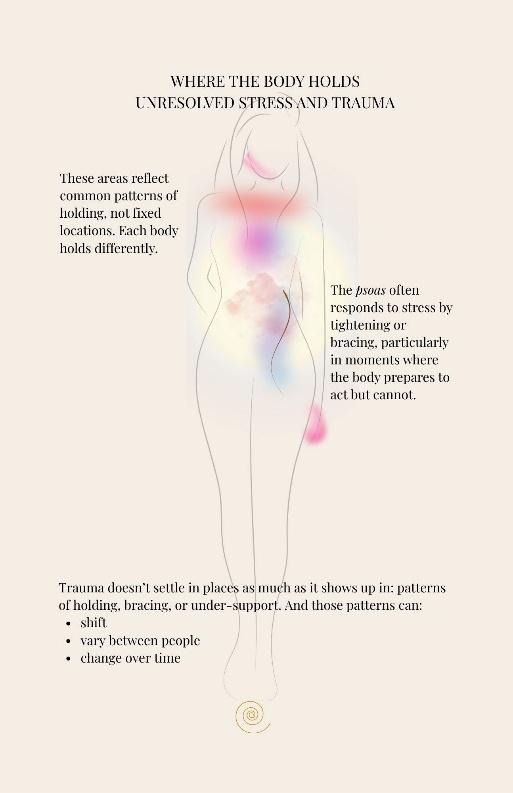
Many people today live with a body that never quite settles. There may not be anything obviously wrong, yet tension lingers. The shoulders remain slightly raised; the jaw holds, the breath doesn’t fully drop, and even at rest, something feels unfinished.
We are often told to relax, to stretch, or to think differently, and while these can help, they don’t always reach the deeper layer of what the body is holding. Because the body doesn’t only need rest. It needs completion.
The Body’s Unfinished Responses
When something stressful happens, the body prepares to act. This is a natural and intelligent response — a surge of energy designed for movement, protection, or escape. In the animal world, this energy is almost always completed. Once the threat has passed, the body discharges what was activated. It may shake, run, or release in a physical way, and then it returns to balance.
Humans, however, often interrupt this process. We stay still when we want to move. We remain composed when something in us is activated. We move on quickly, without allowing the body to finish what it started. Over time, this uncompleted response doesn’t disappear. It remains in the system — not as a memory, but as a pattern of holding.
As described in Waking the Tiger, Peter Levine highlights that it is not only the event itself that affects us, but what the body was unable to resolve in the moment.
It’s Not Only “Big” Trauma
When we hear the word trauma, we often think of extreme experiences. But in modern life, much of what the body carries is quieter and more cumulative.
Traffic.
Deadlines.
Difficult conversations.
Constant stimulation.
The pressure to keep going.
These moments may seem small, but they activate the same physiological responses — often repeatedly, and without resolution. The result is a body that is continually preparing, but rarely completing.
Why Relaxation Isn’t Always Enough
Practices that calm the mind can be helpful. Rest, breathwork, and stillness all play an important role in healing, but if the body is still holding an incomplete response, relaxation alone may not fully resolve the pattern.
In some cases, it can even feel frustrating — as though the mind is calm, but the body hasn’t quite followed. This is why a more integrated approach is needed. As Bessel van der Kolk writes, the body carries these patterns in ways that thinking alone cannot reach.
A Different Way to Approach Release
Release does not have to be dramatic. It is not about forcing something out or reliving the past. Instead, it begins with something much simpler: Creating the conditions in which the body feels safe enough to respond.
Through gentle awareness, slow movement, and a reduction of effort, the body can begin to soften its patterns of holding. As this happens, small, often subtle shifts occur.
The breath deepens.
Muscles begin to let go.
A sense of ease returns — not because something was forced, but because something was finally allowed.
In this way, the body completes what it could not complete before.
A Quiet Return
This approach is not about fixing the body. It is about listening to it differently.
Ancient teachings such as the Bhagavad Gita remind us that change does not always come through effort, but through awareness and right relationship. When we stop pushing for the body to change, we often find that it begins to change on its own.
The Beginning of Relief
For many people, relief does not come from doing more. It comes from allowing the body to finish what it has been holding — sometimes for years, sometimes for a lifetime of small, unprocessed moments. This is not a dramatic process. It is often quiet, gradual, and deeply restorative.
And for a tired, modern body, that quiet shift can be enough.
If you are living with persistent tension, fatigue, or a sense that your body never fully settles, you are not alone. There is a different way — one that begins not with force, but with awareness.
By Lala Menen
About the Author
Lala Menen is a movement and somatic practitioner, a yoga teacher, researcher and author offering gentle, restorative practices that help the body release tension, calm the nervous system, and restore ease of movement.
Her work is an exploration of how the body holds, adapts, and eventually lets go.
Blending somatic practice with quiet contemplative awareness, she offers a gentle approach to restoring ease in the modern body—one that listens rather than forces and allows change to emerge naturally.
Author of The Soma Awakens Understanding SMA and how to undo tense holding patterns in the body to reduce common aches and pains.
Author of Release — A practical guide to easing tension and restoring ease in the modern body (Coming Soon)